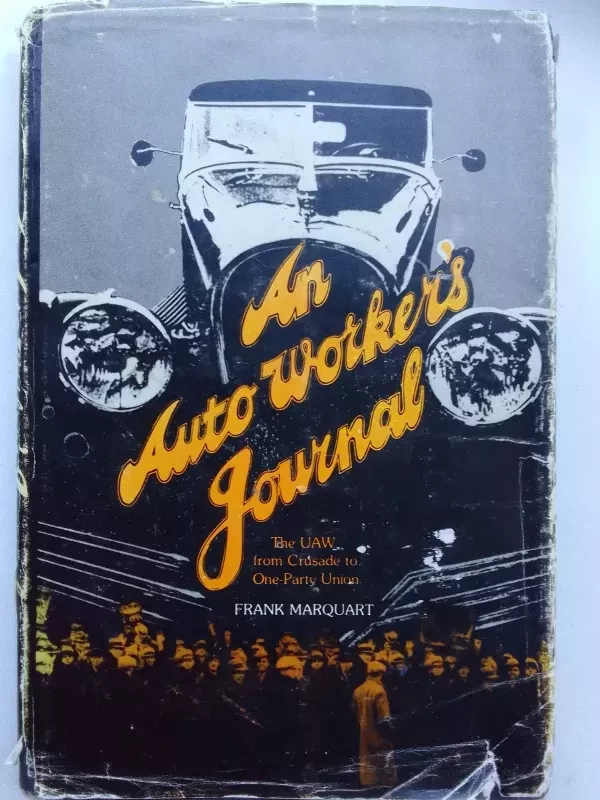



An Auto Worker's Journal: The UAW from Crusade to One-Party Union
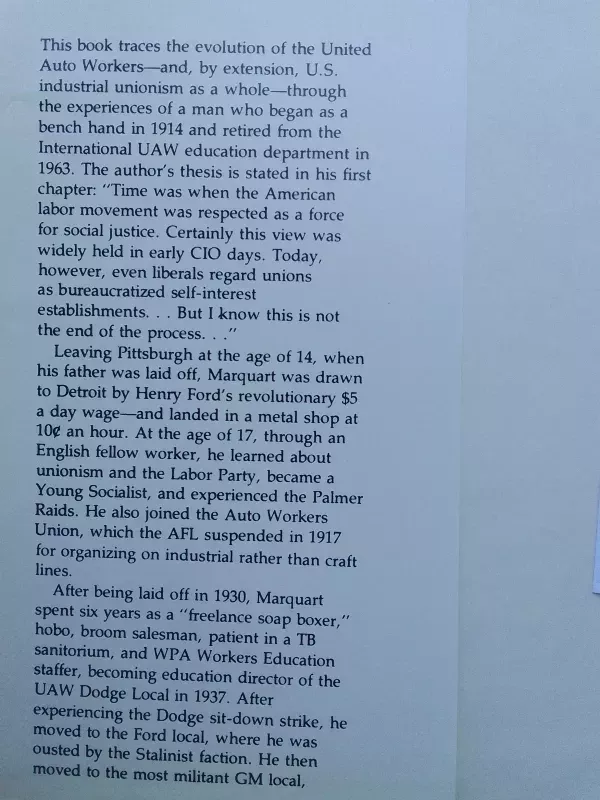
This book traces the evolution of the United Auto Workers—and, by extension, U.S. industrial unionism as a whole—through the experiences of a man who began as a bench hand in 1914 and retired from the International UAW education department in 1963. The author's thesis is stated in his first chapter: "Time was when the American labor movement was respected as a force for social justice. Certainly this view was widely held in early CIO days. Today, however, even liberals regard unions as bureaucratized self-interest establishments. . . . But I know this is not the end of the process . . . ."
Leaving Pittsburgh at the age of fourteen, when his father was laid off, Marquart was drawn to Detroit by Henry Ford's revolutionary five dollars a day wage—and landed in a metal shop at ten cents an hour. At the age of seventeen, through an English fellow worker, he learned about unionism and the Labor Party, became a Young Socialist, and experienced the Palmer Raids. He also joined the Auto Workers Union, which the AFL suspended in 1917 for organizing on industrial rather than craft lines.
After being laid off in 1930, Marquart spend six years as a "freelance soap boxer," hobo, broom salesman, patient in a TB sanitorium, and WPA Workers Education staffer, becoming education director of the UAW Dodge Local in 1937. After experiencing the Dodge sit-down strike, he moved to the Ford local, where he was ousted by the Stalinist faction. He then moved to the most militant GM local, where he taught part-time for the University of Michigan Labor and Industrial Relations Institute, before his final assignment with the UAW International headquarters. Since retiring he has written labor criticism for Dissent, The New Leader, and The New Republic, and has recorded his experience for the oral history project of Wayne State University's Labor Archives.
Drawing upon his own observations, the testimony of rank-and-file unionists, and recent labor history, the author concludes that "today, for all the UAW's liberalism . . . the assembly lines remain plodding, monotonous, pace-driving treadmills."
Kitos pardavėjo prekės
Žiūrėti visas (2133)